How to Play Pickleball: The Gamerian’s Quick Beginner’s Guide

Let’s be honest — the first time most of us hear “pickleball,” we picture a backyard game with a funny name, definitely not something that could leave you sore for three days. My girls and I, we even giggled at the “pickle” part of the name, spamming the cucumber emojis like no tomorrow when discussing our next pickle hangout.
I’m not going to pretend I’m out here smashing dinks like a pro. I’ve played a fair bit at local courts, never had a single lesson, and I still mess up my serve more often than I’d like to admit.
But that’s exactly why I wanted to write this: how to play pickleball, explained the way I wish someone had explained it to me with no jargon, no assumptions, just the basics you actually need before you step on court.
And here’s the thing people get wrong about pickleball — they assume it’s the “lesser” sport, the one you play when tennis or badminton feels too intense. Auntie-uncle sport, some say. At a glance, sure, it looks simple: smaller court, plastic ball, just whack it back and forth. But give it one real game and you’ll realize there’s a lot more going on: footwork, timing, patience, and a whole lot of restraint when every instinct tells you to smash.
So whether you searched “how to play pickleball” or typed “cara main pickleball” into Google, here’s your quick-start guide.
Also read: 18 Top Esports Games All Time Ranked by Prize Money
What Exactly Is Pickleball?
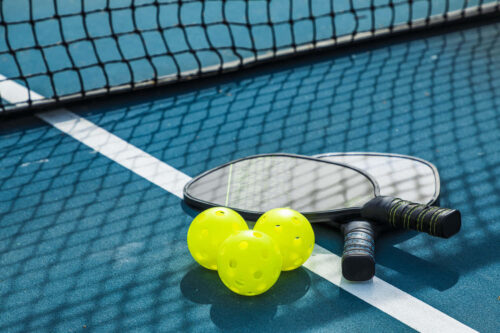
Pickleball is basically what you’d get if tennis, badminton, and table tennis had a baby. It’s played on a court about the size of a badminton court, with a net slightly lower than a tennis net, using solid paddles (not strung rackets) and a plastic ball full of holes, kind of like a whiffle ball. You can play singles, but it’s far more common — and honestly more beginner-friendly — to play doubles, since you’ve got a partner covering half the work with you.
Also read: How to Play Madden for Money
What You Need to Get Started
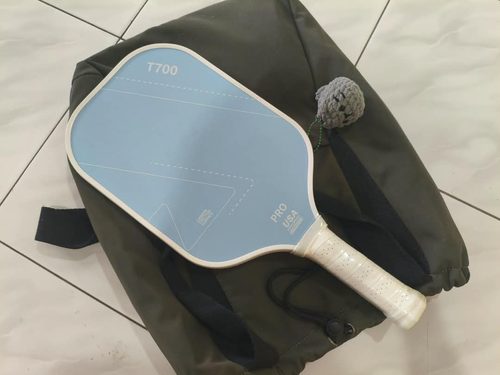
You don’t need to invest much to try it out:
- A paddle: Beginner paddles are widely available and generally cost around RM50–RM100. Most courts also offer rental sets, so you don’t need to buy anything before your first session. I was lucky to get mine for free, thanks to a close friend who noticed I got into the pickleball trend and bought me a beginner paddle as a birthday pressie hehe…birthday gift ideas anyone? 😉 If you want something that isn’t unbranded, consider getting JOOLA paddles like this one, or this Selkirk LABS Project Boomstick one could be the very paddle to get you pickling like no tomorrow (more colors and designs for this one!).
- Pickleballs: Outdoor balls have smaller, harder holes; indoor balls are lighter with bigger holes. If you’re not sure which your court uses, just ask when you book. You can get some new pickleballs here.
- Court shoes: Something with good grip and lateral support, like this one. Running shoes are not it; you’ll be doing a lot of quick side-to-side movement.
- Comfortable, breathable clothing: Malaysian heat and humidity are undefeated, so dress like you’re going for a proper workout, because you are.
The Court and Basic Setup
A pickleball court is 20 feet by 44 feet, split by a net that’s 34 inches high at the center. On each side, closest to the net, there’s a 7-foot zone called the “kitchen” (officially the non-volley zone). You’re not allowed to hit the ball out of the air while standing inside this zone — you have to let it bounce first. This one rule alone trips up almost every beginner (myself included) in their first few games.
Indoor vs. Outdoor Pickleball Court: Does It Actually Matter?
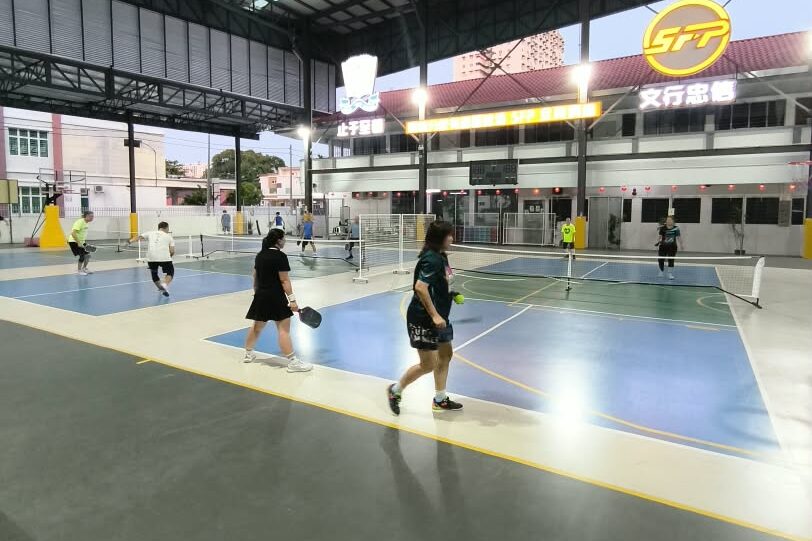
Short answer: yes, a little more than you’d expect. Outdoor courts (usually asphalt or concrete, similar to what you’d find at a tennis or futsal court) use a ball with smaller, harder holes so it can hold up against wind and rougher surfaces without losing its bounce. Indoor courts use a lighter ball with bigger holes, built for smooth wooden or rubberized flooring — think converted badminton or futsal halls, which is what most “indoor” pickleball venues in Malaysia actually are.
The practical difference shows up in how the game feels. Indoor games tend to play a touch slower and more controlled since there’s no wind messing with your dinks, and the softer ball doesn’t fly off your paddle as fast. Outdoor games are faster-paced and less forgiving, on top of dealing with our heat, humidity, and the occasional surprise downpour.
If you’re just starting out, indoor courts are the more beginner-friendly pick — one less variable to fight while you’re still figuring out your paddle control. Just don’t show up with the wrong ball for the setting; using an outdoor ball indoors (or vice versa) changes the bounce enough to throw off your whole game.
Also read: E Sukan
How to Play Pickleball: The Basic Rules
Here’s the part everyone actually searches for. The core rules are simple once they click:
- The serve: Serves must be underhand, hit below waist height, and land diagonally in the opponent’s service court. No overhead serves like tennis.
- The two-bounce rule: After the serve, the receiving side must let the ball bounce once before returning it. The serving side must then also let the return bounce once before hitting it back. Only after these two bounces can either side start volleying.
- The kitchen rule: You can’t volley the ball while standing in the non-volley zone. Step in only after the ball has bounced.
- Scoring: Traditionally, only the serving side can score a point, and games are usually played to 11, win by 2. Score is called out as three numbers in doubles: your team’s score, the opponent’s score, and which server (1 or 2) is currently up.
It sounds like a lot written out, but after one or two rallies, your body picks it up faster than your brain does.
One thing that trips up beginners moving between courts: not every venue sticks to the traditional 11-point, win-by-2 format above. In Malaysia, local groups often run their own house rules — some KL courts play rally-scoring games up to 21 points, while several courts in Penang stick to 15-point rally scoring instead.
Rally scoring simply means every rally wins a point for someone, regardless of who served, so games move faster and score differently from the traditional format. Always check the house rules before your first game so you’re not the one arguing over the score at 10-all.
Also read: The Top 10 NFL Football Teams of All Time
Beginner Tips That Actually Help
A few things I learned the slow way, so you don’t have to:
- Master the dink before the smash. A dink is a soft, controlled shot that just clears the net and lands in the kitchen. It’s not flashy, but it’s the shot that wins beginner games.
- Stay patient. Pickleball rewards consistency over power. Resist the urge to smash every ball — most points are lost through unforced errors, not won through aggression.
- Warm up properly. It looks casual, but the quick direction changes are tough on your knees and ankles, especially if you’re not used to racquet sports.
- Play doubles first. It’s more forgiving for beginners since you’ve got less court to cover and someone to learn alongside.
Also read: How to Play Go Game or Weiqi for Beginners
Do You Need a Pickleball Coach?
I used to discuss this with my girls, whether us being noobs at the sport means we should just train under a pickleball coach to speed our pickleball skill progress. The short answer is: not to start, but it helps sooner than you’d think.
I’ve never taken a single lesson, and you genuinely can pick up the fundamentals just by playing consistently and watching a few short videos online. I still enjoy my moments playing as a beginner, and I manage to improve along the way too. But here’s the catch — bad habits creep in fast, especially with your serve and dink technique, and once they’re baked in, they’re a lot harder to unlearn than to learn correctly the first time.
If you’re serious about improving past the “just having fun” stage, even one or two beginner clinic sessions (many courts run these, and they’re usually cheaper than private 1-on-1 coaching) can save you months of self-correcting on your own.
Also read: Top 6 Best Free Football Streaming Apps
What’s DUPR and Should You Care?
If you stick with pickleball long enough, you’ll eventually run into the term DUPR — short for Dynamic Universal Pickleball Rating, basically a global skill rating system for the sport, kind of like a chess ELO. It’s a number (usually somewhere between 2.0 and 8.0) that reflects your skill level based on match results, and it’s increasingly used to match players of similar skill for games, round-robins, and tournaments.
As a total beginner, you don’t need to worry about it at all — most casual courts and pickup games don’t require a rating. But once you start playing more organized sessions or want an objective way to track your progress, creating a free DUPR profile and logging a few rated matches is worth doing.
Where to Play Pickleball in Malaysia
The good news is you’re not short on options — pickleball has exploded here over the last couple of years, with courts popping up in community sports centers, private clubs, and multi-purpose halls across states, not just in the Klang Valley.
Rather than pointing you to one or two specific courts (there are genuinely too many now, and new ones keep opening), your best bet is to check court-booking apps such as Reclub (I started here), local Facebook and WhatsApp community groups, or simply search “pickleball court near me”, chances are there’s one closer than you’d expect. Court rentals typically run around RM20–RM60 per hour, depending on the state, facility, and whether it’s indoor or outdoor.
Final Thoughts
Pickleball’s biggest strength is how quickly it lets you feel like you’re actually playing, instead of standing around learning drills for weeks. Grab a paddle, find a court, rope in a couple of friends, and just get a few rallies going — the rules will make a lot more sense once the ball is actually in play.
You’ll mess up the serve at least once.
Everyone does.
Welcome to the club.